The average life expectancy in Hungary is currently around 73 years for men and 79 years for women, leaving a relatively large group of single older women who are significantly less likely to be able to obtain information and get involved in projects that shape their environment. The PlaceLab was designed to help alleviate the social isolation and loneliness of single women, while channelling social capital to achieve the district’s Climate Strategy objectives.
We evaluated a set of targeted measures for single senior women. Lectures, workshops and community events – organised around the themes of rain garden maintenance, gardening, and green space maintenance – brought to the localities give an opportunity for senior women to meet, periodically discuss, to share experiences and get support from each other. We found the right framework for our PlaceLab: Budapest18 has an ongoing program for senior citizens, called Senior Academy. We implemented our PlaceLab in its Framework with success.
In February 2025, as the opening presentation of the Senior Academy, we invited Mr Sándor Bardóczi, the Chief Landscape Architect of Budapest – responsible for maintaining, developing, and protecting the capital’s green spaces – to give a lecture. In his presentation, he talked about the positive effects of Nbs on environmental quality and climate change adaptation. He also showed complex green-blue solutions realised in Budapest over recent years, highlighting the importance of rain gardens and rainwater retention. To quote the chief architect: “On a Saturday morning on an empty stomach, talking about rain gardens and water retention in the capital doesn’t seem like a topic that would draw huge crowds. And when you walk into the large hall of a cultural centre and find it completely filled, you wonder whether the focus of public discourse is really well calibrated. Because it really seems that people are genuinely interested in how to retain urban rainwater in a backyard, or municipal or business setting.” (Sándor Bardóczi, Facebook post, February 1, 2025)
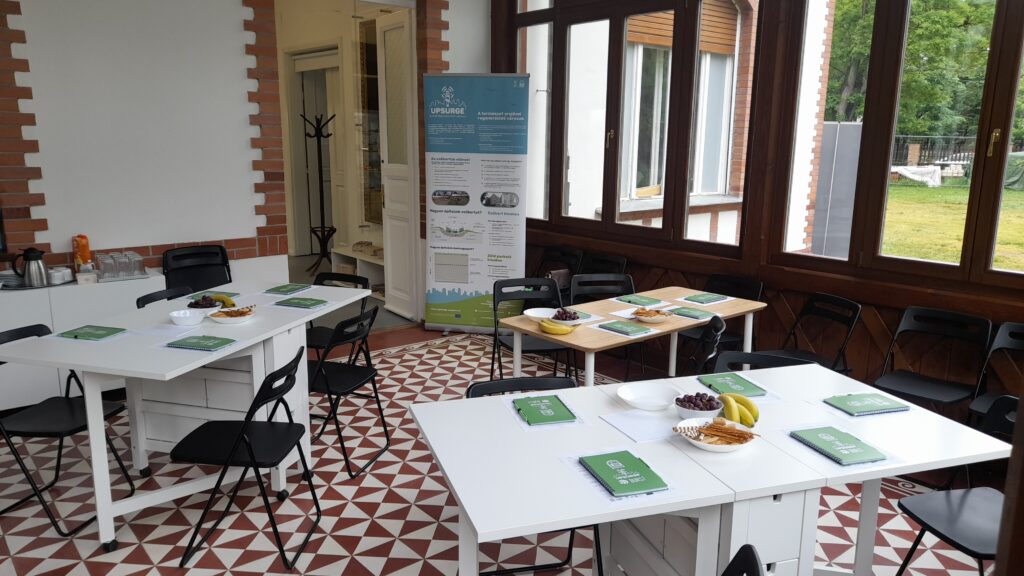
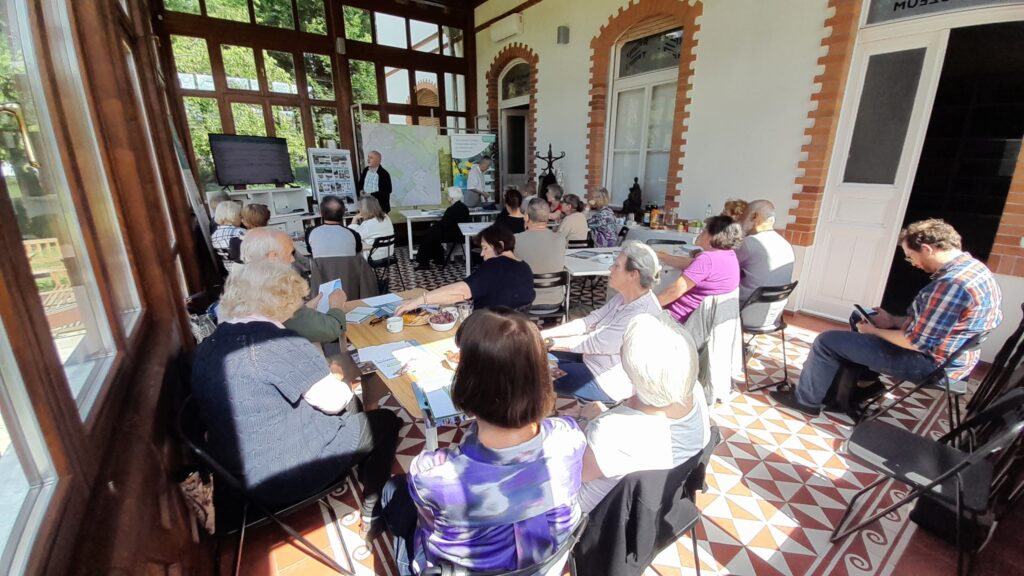
The presentation provided an excellent foundation for the four-part training series, which were held in May 2025. Each training session was designed as a half-day program, with a mixed methods to balance gaining knowledge, raising awareness (ecosensitivisation), communicate and highlighting areas where citizen participation can be enhanced.
Participants learned about the basics of nature-based solutions through many international, national, and local examples and their local application possibilities. During our sessions, participants listened to presentations and had the opportunity to engage in discussions with our speakers. Enthusiastic and lively conversations ensued, allowing participants to learn not only from the speakers but also from each other. Each lecture was followed by small group tasks, which provided an opportunity to delve deeper into district environmental and climate issues in practical examples, how to apply what they had heard.
We introduced a large map of BP18 to localise climate-related problems. Participants were asked to identify climate change-related problems specific to their streets. While urban blocks and housing estates struggle with heat islands, in the garden-street areas, topography, pavement coverage, and local interventions (ditch filling, concrete retaining walls) result in flash floods and water damage.
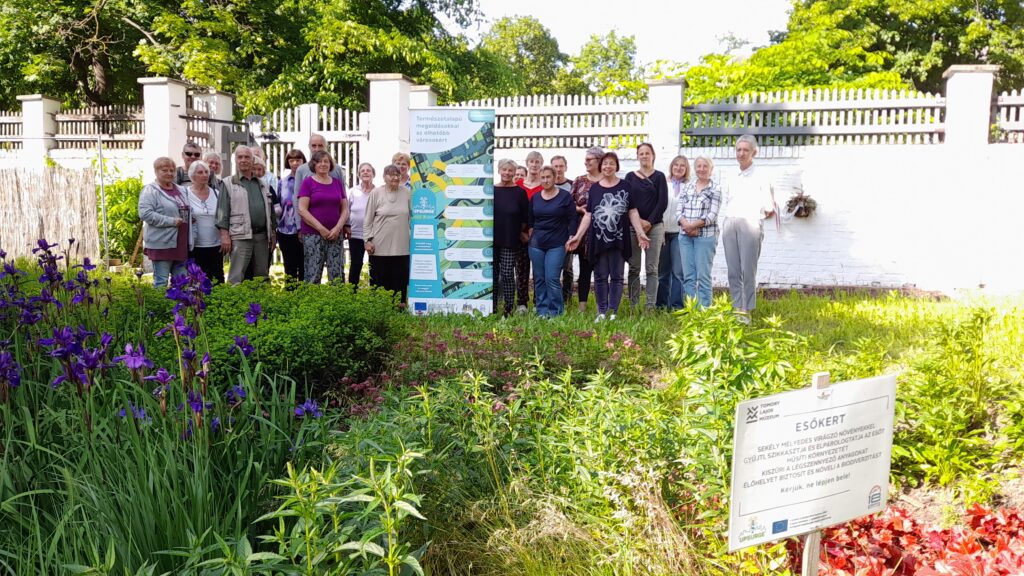
One of the sessions in the series was devoted to visiting rain gardens and green solutions implemented in the district. During the tour, participants assessed how much the solutions presented help to solve the district’s climate and environmental problems (air quality, flash floods, summer temperatures), how aesthetically pleasing they are, how useful they are to the local population, and how they can be considered as models (design, implementation, maintenance) for similar projects. The ranking helped to highlight the success factors of a rain garden or NbS.
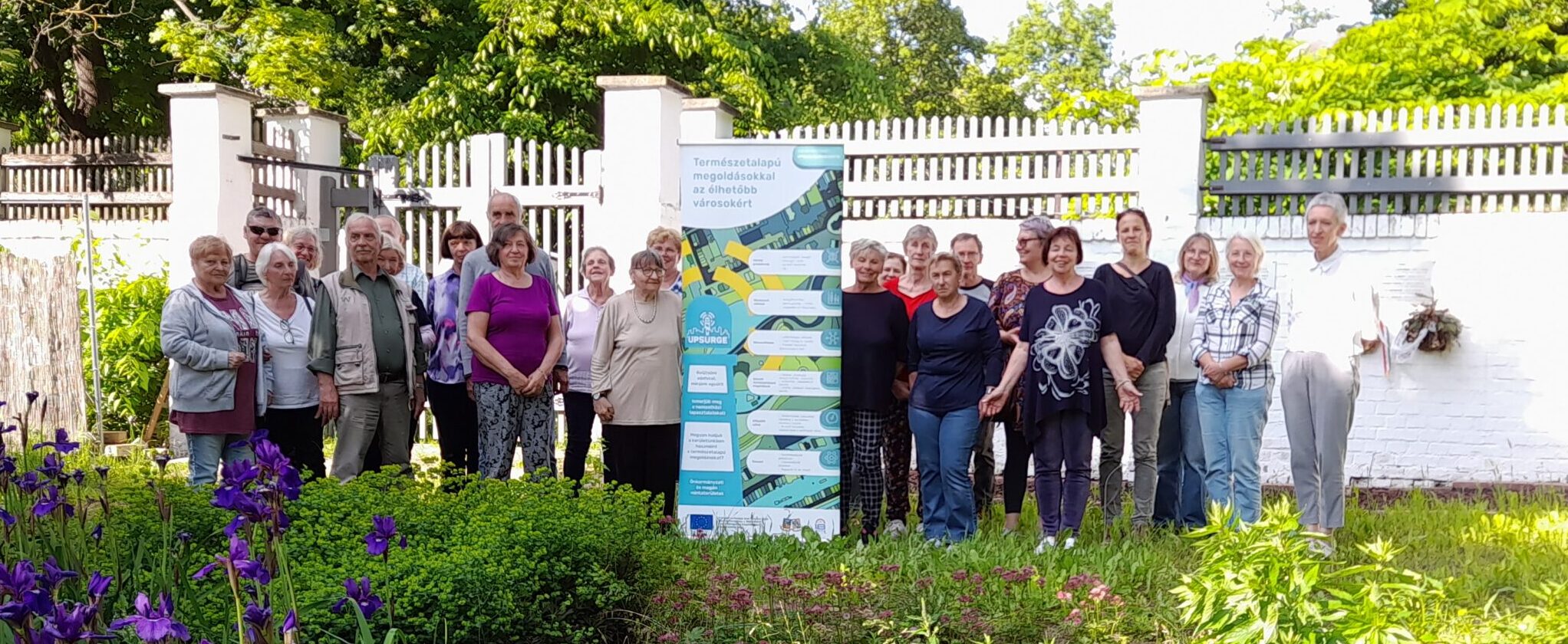
Our venue was the Tomory Lajos Museum, where the earliest rain garden was established, which could be visited by the participants repeatedly during the training. At this location, we could show native, easy-to-care-for plant species and bring the importance of soil, the role of mulching, and weeding closer to life.
As a result of the training program, the participants gained knowledge about local environmental issues and NbS. The knowledge about local climate change and environmental issues increased from 4.48 to 7.55, of urban nature-based solutions from 4.33 to 7.5, and of rain gardens from 3.48 to 8.05 (1 to 10 scale). Participants rated the training at 9.75.
The course was organised by the Municipality of Pestszentlőrinc-Pestszentimre, Budapest, within the framework of the UPSURGE project, with the participation of its professional staff and within the framework of the Senior Academy. To broaden the interaction between local stakeholders, other partners were involved, like BURST, Városgazda18, the Lajos Tomory Museum, and a local NGO, the Civil Greeners Association.